Network audio has transformed the way we carry sound between devices, computers, studios and venues. But not all audio-over-network technologies solve the same problems. One of the questions I get asked most often is:
“How does Blue Cat Connector compare to Dante or AVB? If they all send audio over a network, aren’t they essentially doing the same thing?”
The short answer is no. The more I answer this question, the more I realize that Connector is often being compared to products that solve a completely different problem. Dante and AVB are designed to build audio networks. Connector is designed to connect audio software and systems.
So before asking which solution is “better”, it’s worth understanding what each one was designed to do.
Let’s take a closer look.
Why AVB and Dante Exist
AVB (Audio Video Bridging) and Dante emerged from a common need: transporting large numbers of audio channels between hardware devices with low latency and high reliability.
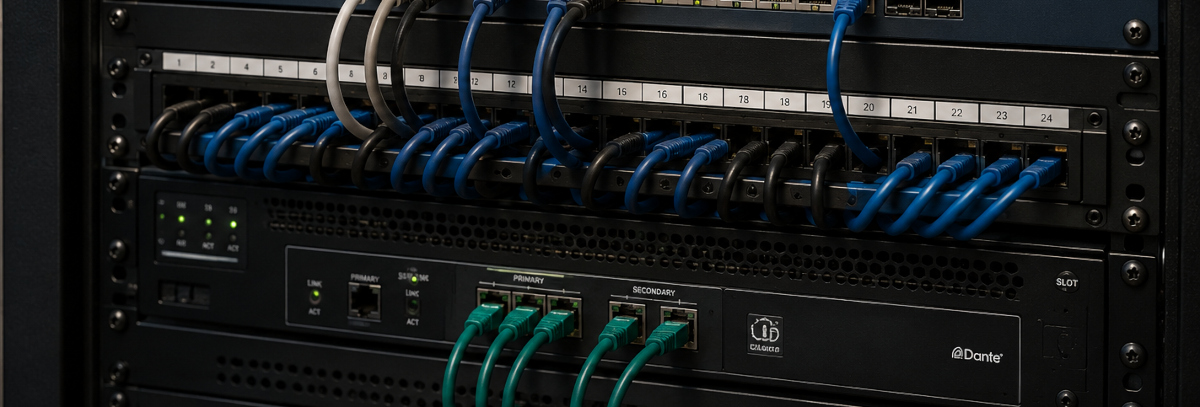
Audio-over-IP technologies such as AVB and Dante basically replace physical (analog or digital) audio cables with Ethernet networks: instead of running dozens or hundreds of analog or digital connections, audio travels across a shared network infrastructure via a single cable.
Why Connector Exists
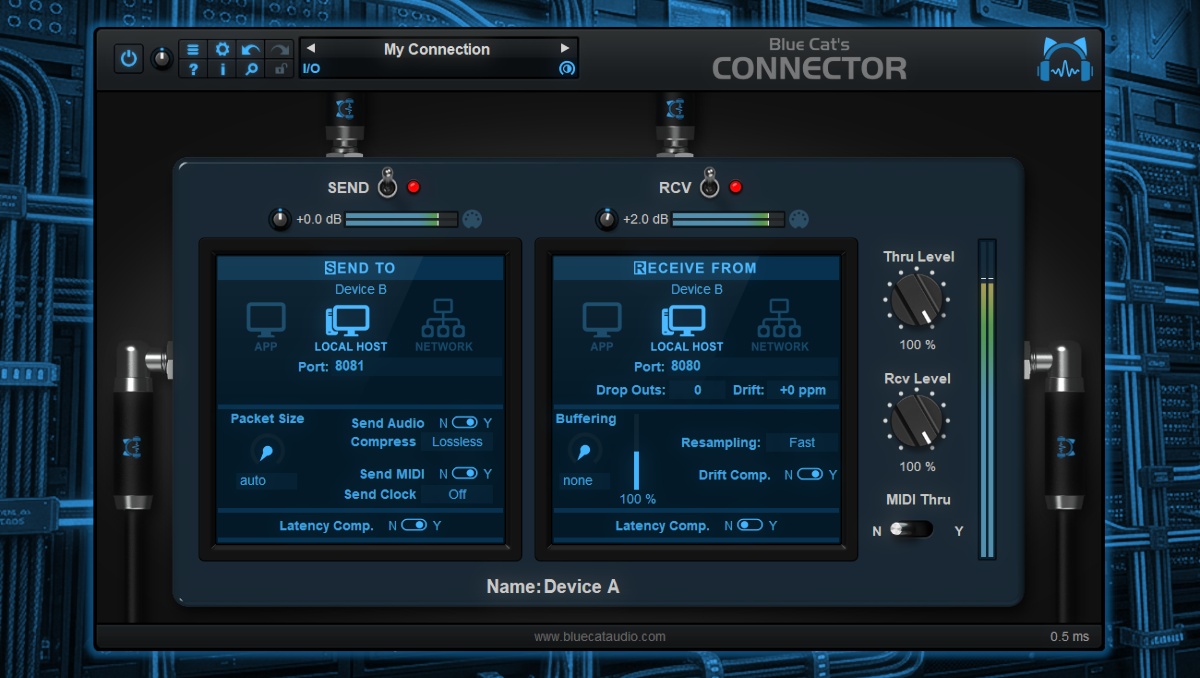
Blue Cat’s Connector and its protocol (also used by Fader Hub and Freeceiver) started from a completely different problem. Not “How do we connect more hardware devices?”, but rather: “How do we connect anything that produces or consumes audio?”. That includes:
- DAWs
- Plugins
- Virtual instruments
- Standalone applications
- Multiple computers
- Remote systems
In modern production environments, audio often needs to move between software components rather than hardware devices. A producer may want to:
- Run virtual instruments on a second computer.
- Process audio remotely on a powerful workstation.
- Connect two DAWs together.
- Route audio between applications.
- Send MIDI and audio simultaneously.
- Collaborate with someone in another city.
- Render projects offline without changing the workflow.
- …
These are not problems AVB or Dante were originally designed to solve: both Dante and AVB can move audio between networked endpoints. But neither technology was designed around the idea that software applications themselves (or any location inside of them) are the endpoints, while Connector treats applications, plugins and computers as first-class citizens.
As a result, it can easily create workflows that would otherwise require combinations of virtual audio cables, network drivers, remote desktop software, hardware interfaces and custom routing setups.
Local Networks Are Only Part of the Story
Also, Connector was designed from the beginning with both local and remote connectivity in mind (it has been developed during the COVID crisis…) , whether systems are:
- In the same application.
- In the same computer.
- In the same room.
- In different rooms.
- In different buildings.
- In different countries.
- In different universes? Well huh… not yet!
AVB is fundamentally a local-network technology. Dante can be extended across routed networks and managed infrastructures, but this often requires additional planning and specialized solutions. They were not initially designed with the Internet in mind.
AVB, Dante and Connector Compared
AVB: Deterministic Performance for Dedicated Networks
 AVB is a family of IEEE standards (designed to provide guaranteed bandwidth and timing over Ethernet. It relies on specialized AVB-capable switches and endpoints.
AVB reserves network bandwidth and synchronizes clocks across devices using standards such as IEEE 802.1AS (gPTP). The network itself guarantees that audio packets arrive on time.
Advantages
- Open standard rather than a proprietary protocol.
- Deterministic network behavior.
- Scales to very large installations.
Limitations
- Requires AVB-compatible network infrastructure.
- Limited flexibility outside dedicated AVB networks.
- Not designed for Internet-based workflows.
Dante: IP Audio Networks
 Dante is a proprietary Audio-over-IP system from Audinate that runs over standard Ethernet/IP networks. Dante encapsulates audio into IP packets and transports them over (almost) ordinary Gigabit Ethernet networks.
Most deployments use standard managed switches rather than specialized AVB hardware.
Advantages
- Works over standard IP networking.
- Scales to very large installations.
Limitations
- Proprietary technology with licensing costs.
- Primarily designed for local and managed networks.
- Less practical for ad-hoc software routing between applications.
- Not designed for Internet-based workflows.
- Higher latency when not using dedicated hardware (software driver).
Blue Cat Connector: Flexible Audio Routing
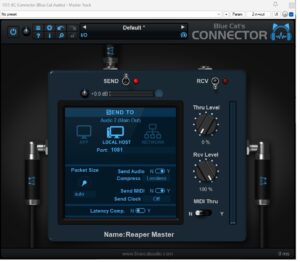 Instead of building a dedicated audio network, Connector acts as a virtual audio and MIDI cable that can connect applications, DAWs and computers directly.
It supports audio and MIDI streaming between software applications, across multiple computers and even through the Internet.
It also includes resampling and drift compensation, allowing systems with different sample rates or independent clocks to communicate without complex configuration.
Advantages
- No specialized network hardware required.
- Works between applications on the same machine.
- Works between multiple computers.
- Supports both audio and MIDI.
- Can operate over local networks or the Internet, with remote systems synchronization.
- Allows routing configurations that traditional AoIP systems do not typically address.
- Supports feedback loops and creative signal-routing workflows.
Limitations
- Not intended to replace large-scale physical network infrastructures.
- Latency depends on the underlying network, applications and audio interfaces.
- Relies on host computers rather than dedicated hardware endpoints.
- Limited to 32 audio channels per instance.
Summary Table
| AVB | Dante | Connector | |
|---|---|---|---|
| Primary goal | Deterministic audio transport | Audio over IP networking | Audio software connectivity |
| Network Layer | Layer 2: Ethernet | Layer 3: IP Protocol | Layer 5: Applicative over TCP |
| Typical latency | Extremely low | Extremely low | Low |
| Works over Internet | No | Limited | Yes |
| Hardware ecosystem | Yes | Yes | Not required |
| MIDI transport | Possible (In Theory) | Limited Compatibility | Yes |
| Application-to-application routing | No | Limited | Yes |
| Create multiple endpoints within an application | No | No | Yes |
| Offline bounce/freeze | No | No | Yes |
| Cost | Higher | High | Low |
What About Latency?
 Latency is often the first specification people look at when comparing network audio solutions. And AVB and Dante were specifically designed to achieve extremely low and predictable transport latencies across professional audio networks using a shared clock infrastructure via the network.
If your goal is to distribute hundreds of channels throughout a venue, connect stage boxes to consoles, or build a large-scale audio infrastructure to connect many pieces of hardware, these technologies are definitely hard to beat.
Connector takes a different approach. Because it operates at the application level rather than the network-infrastructure level, its latency depends on factors such as audio buffer sizes, network performance and host computer configuration. However, in a typical Gigabit Ethernet setup, Connector can achieve latencies low enough for real-time music production and performance, often in the range of just a few milliseconds.
Connector is also able to estimate and have the host application compensate for any latency (due to the network or buffering) to keep all audio sources in sync.
Offline Rendering and Freeze
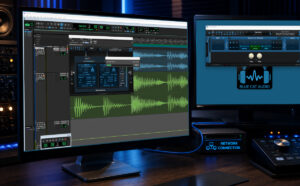 Historically, network audio solutions have focused on real-time transport. This creates an interesting challenge for DAW users as real-time routing is only part of a production workflow: projects also require to freeze tracks, bounce stems, export mixes etc.
With the addition of offline rendering, freeze and bounce support, Connector now participates in these workflows as well.
This may sound like a small feature, but it changes the role of the software significantly: a remote instrument, processor or application is no longer limited to real-time playback. It can now behave much more like a native component of the project itself. This moves Connector beyond simple audio transport and closer to becoming part of the production environment.
So… Which One Should You Choose?
The answer ultimately depends on what problem you are trying to solve:
- For hardware-centric audio networks, AVB and Dante are definitely excellent solutions.
- For software-centric audio and MIDI routing between computers, DAWs, applications and remote systems, Connector offers a level of flexibility that traditional audio-networking technologies were not designed to provide.
To make it simple, I would say that AVB and Dante extend the audio network, while Connector extends the DAW itself. Also, you can use Connector as a software bridge between several hardware audio networks: all these techs can work well together too!